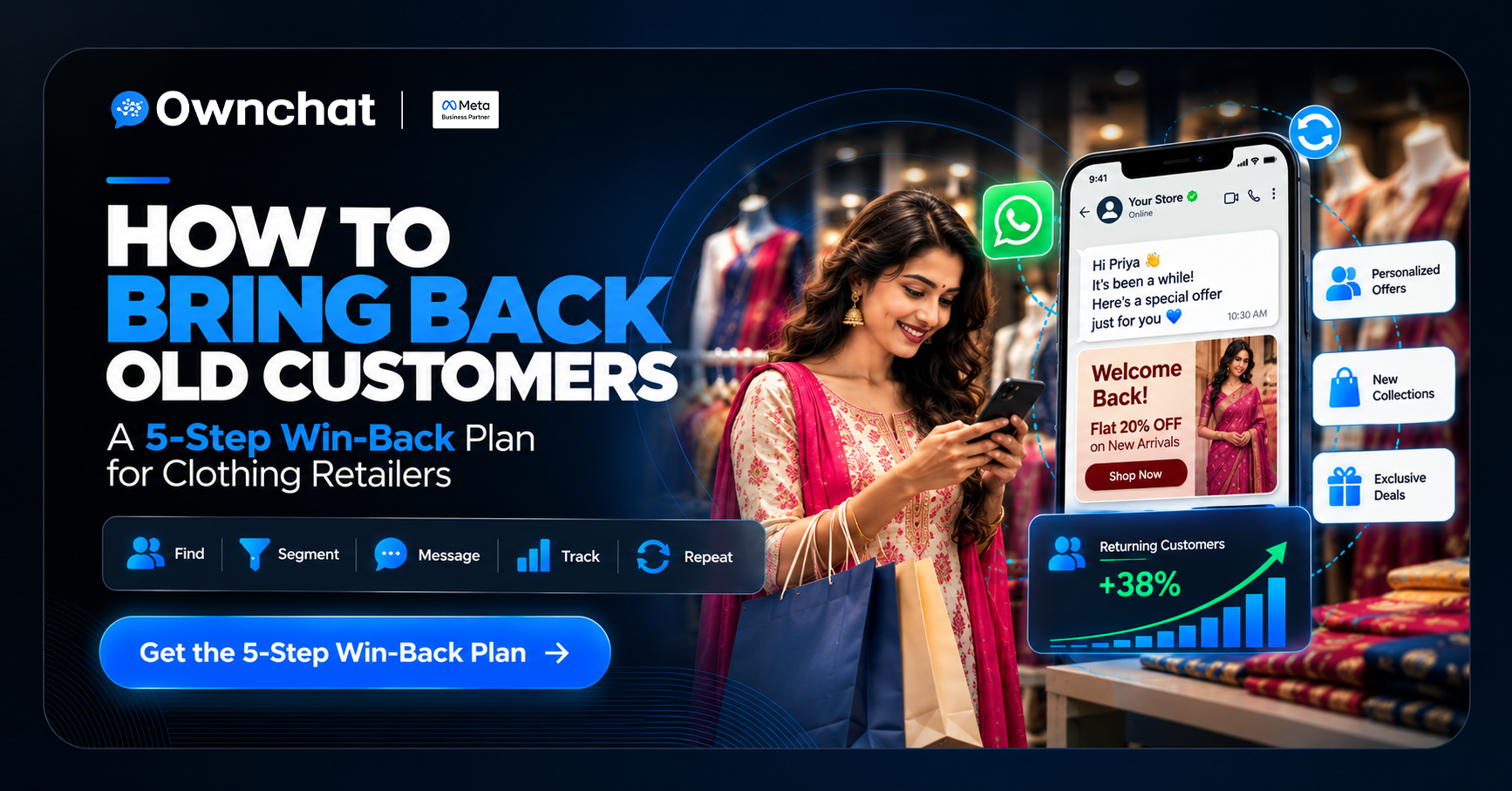
Quick answer: To bring back old customers, find everyone who hasn't bought in 6–18 months from your billing data, group them by how long they've been away and how much they used to spend, then send a short, personal sequence — a "we miss you" message, a time-limited offer, and a final reminder — and track who returns with a bill.
Key takeaways
- Lapsed customers already know your store; they just need a reason and a reminder.
- Group by recency first — a customer gone 7 months needs a different message than one gone 2 years.
- Three messages over 10–14 days is usually enough. More feels like spam.
- Count returns by actual bills, and compare against a group you didn't message.
In this guide
- Why do customers stop coming back?
- How do you find lapsed customers?
- What is the 5-step win-back plan?
- What should the win-back messages say?
- What offer should you give?
- FAQs
Why do customers stop coming back to a store?
Usually it isn't dissatisfaction. Common reasons in clothing retail:
- They forgot — no reminder since their last festival purchase.
- A competitor reached them first with an offer or new collection.
- Their need changed — a wedding is over, children grew, they moved.
- They had one bad experience (stock-out, long wait, tailoring delay) and nobody followed up.
Only the last reason needs fixing inside the store. The first three are solved by timely, relevant messages.
How do you find lapsed customers in your billing data?
Export customers with phone number, last purchase date, number of bills and total spend from your POS. Then place each customer on a recency ladder:
| Recency band | Last bill | Status | Priority |
| Active | 0 -3 months | Don't treat as lapsed | Normal campaigns |
| Cooling | 3 - 6 months | At risk | Gentle Reminder. |
| Lapsed | 6 - 12 months | Win-back target | High |
| Deep lapsed | 12 - 18 months | Win-back target | Medium - needs a stronger reason |
| Dormant | 18+ months | Low response expected | Test a small group first |
Then add spend: a lapsed customer who used to spend ₹20,000 a year deserves a more personal approach than a one-time ₹800 buyer. Combining recency, frequency and spend is called RFM segmentation — explained in how to measure WhatsApp marketing ROI.
What is the 5-step win-back plan?
- Pull the list. Export lapsed (6–18 months) customers with valid mobile numbers and marketing consent.
- Segment. Split by recency band and by spend (top 20% vs the rest). Add category if you have it (sarees, menswear, kids).
- Hold out a control group. Randomly keep 10% of the list un-messaged so you can measure true lift.
- Send a 3-message sequence over 10–14 days (below), on WhatsApp for opted-in customers and SMS for the rest.
- Measure and follow up. Match returning customers to bills, compare against the control group, and move winners back into your regular "active" list.
What should win-back messages say?
Message 1 — Day 0: Reconnect (no hard sell)
Hi Priya, it's been a while since your last visit to Sri Lakshmi Silks. Our Deepavali Kanchipuram collection has just arrived — reply SILK and we'll send you 5 picks in your favourite colours.
Message 2 — Day 4: The reason to come back
Priya, as a returning customer, here's ₹300 off on purchases above ₹3,000. Valid till 2 November. Show this message at the counter.
Message 3 — Day 10: Final reminder
Your ₹300 voucher ends on Sunday. Stitching slots for Deepavali are filling fast — reply SLOT to book yours.
Keep each under 60 words, add one image, and use the customer's name and last category.
What win-back offer should you give?
| Message type | WhatsApp category | Example |
| New arrivals / festival collection | Marketing | "The Kanchipuram silk collection for Deepavali is in. Reply SILK to see 10 picks." |
| Offer / early access | Marketing | "Early access for our regular customers: 20 Oct – 25 Oct." |
| Stitching ready / alteration done | Utility | "Your blouse stitching is ready for pickup." |
| Bill / order confirmation | Utility | "Thank you for shopping. Your bill: ₹4,850." |
Avoid large blanket discounts: they train customers to wait for sales.
How Ownchat helps
Ownchat reads your POS data, builds recency and spend segments automatically, sends the win-back sequence on WhatsApp, and matches returning customers to bills. A silk saree shop in Sivagangai, for example, recorded ₹1.36 lakh in attributed sales from ₹10,861 in campaign spend.
Results are historical, anonymised and attributed by OwnChat's message-to-bill matching; they are not a guarantee.
Next step: Planning festive win-backs? Pair this with Diwali marketing ideas for clothing stores, WhatsApp marketing for textile shops and how to send bulk WhatsApp messages without getting blocked, or get a free 15-minute Deepavali Growth Audit to see how many lapsed customers are in your data.
Frequently asked questions
1.What counts as a lapsed customer in clothing retail?
Usually someone with no purchase for 6 to 18 months. Clothing has festival cycles, so a customer who missed one major festival is at risk.
2.Is it cheaper to win back an old customer than find a new one?
Generally yes — you already have their number and they know your store, so there's no ad cost to reach them.
3.How many win-back messages should I send?
Three over 10–14 days is a good default: reconnect, offer, reminder. Stop if they opt out.
4.Should I give a discount to bring customers back?
A fixed-value voucher with a short expiry works better than a big percentage discount and protects margin. High spenders often prefer early access or free services.
5.How do I know if my win-back campaign worked?
Compare the return rate of messaged customers against a random control group that received nothing, using actual bills.
Sources
- TRAI — Telecom Commercial Communications Customer Preference (Amendment) Regulations, Feb 2025 (for SMS consent rules)
.png)